Percentage Difference: How to Calculate It (Formula + Examples)
Learn how to calculate percentage difference between two numbers. Includes the formula, step-by-step examples, and when to use percentage difference vs percentage change.
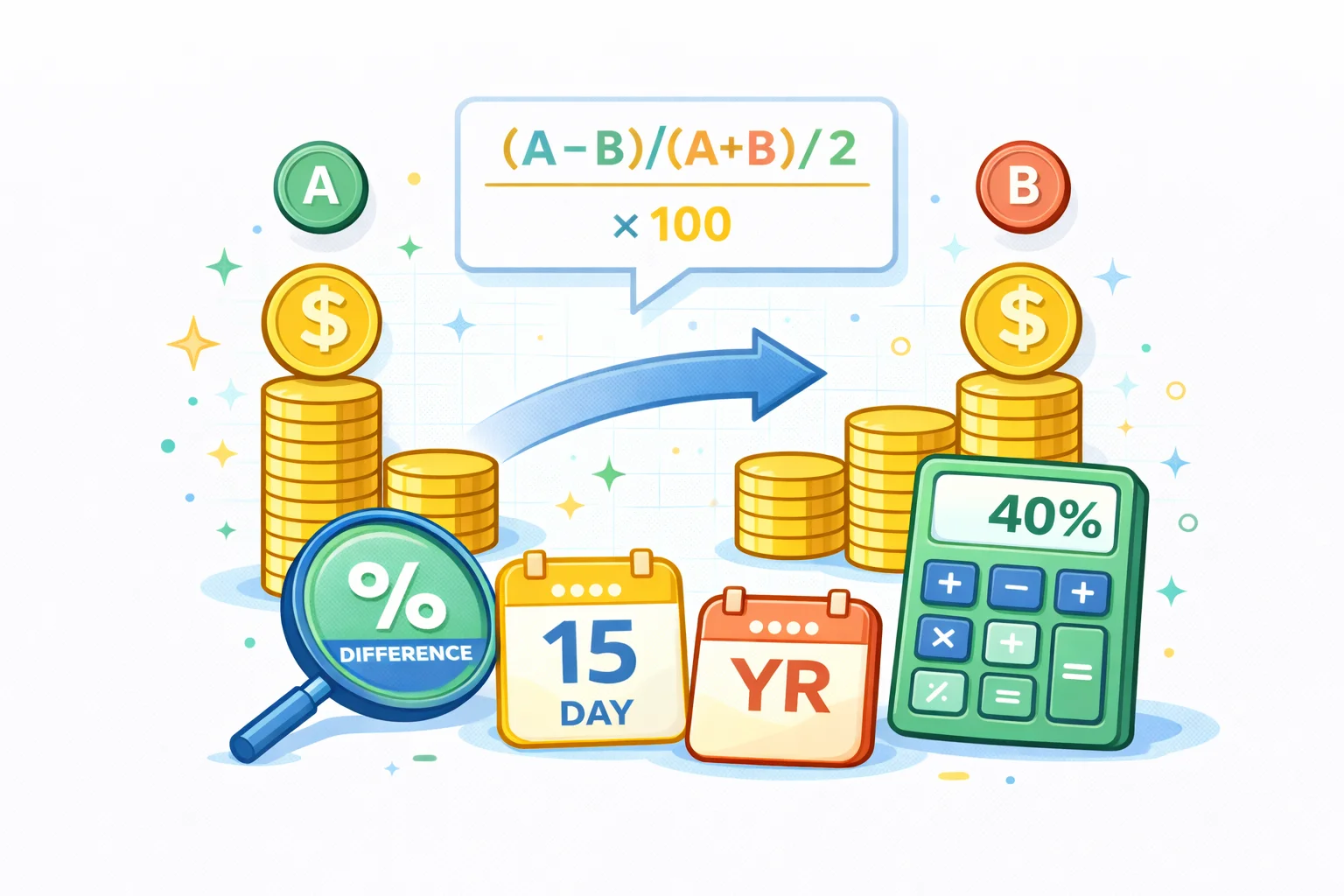
Percentage difference is a way to compare two numbers when you do not want to treat either one as the single "original" value. It is often used to compare measurements, estimates, or results from two methods.
Percentage difference formula
The most common formula uses the average of the two values as the baseline:
Percentage difference = (|A - B| / ((A + B) / 2)) * 100Step-by-step example
Example: compare 40 and 50.
- Find the absolute difference:
|40 - 50| = 10 - Find the average:
(40 + 50) / 2 = 45 - Divide and convert to percent:
(10 / 45) * 100 = 22.22%
Percentage difference vs percentage change
Use percentage change when one value is clearly the starting point (Old to New). Use percentage difference when you want a symmetric comparison.
- Percentage change guide: How to calculate percentage change
- Increase vs decrease: Percentage increase vs decrease
Shortcut: use a percentage calculator
If you want the math done instantly, you can use our tool: Calculate Percentage Online.
Related guide
FAQ
Why do we divide by the average?
Dividing by the average makes the comparison symmetric, so swapping A and B gives the same percentage difference.
Is percentage difference the same as percent error?
No. Percent error usually compares an observed value to a true or accepted value. Percentage difference compares two values without assuming one is the true value.