Reverse Percentage Calculation: How to Find the Original Number Before a Percentage Change
Learn how to calculate original values before percentage changes with simple formulas and practical examples.
Introduction
Have you ever looked at a sale price and wondered what the original price was? Or seen your salary after a raise and wanted to calculate what you earned before? These situations require reverse percentage calculation, a method for finding the original number when you know the result after a percentage change.
Unlike standard percentage calculations where you find a percentage of a known number, reverse percentage works backward. You know the final amount and need to find the starting value. This guide covers the essential formula, practical examples, and common pitfalls to avoid.
The Reverse Percentage Formula
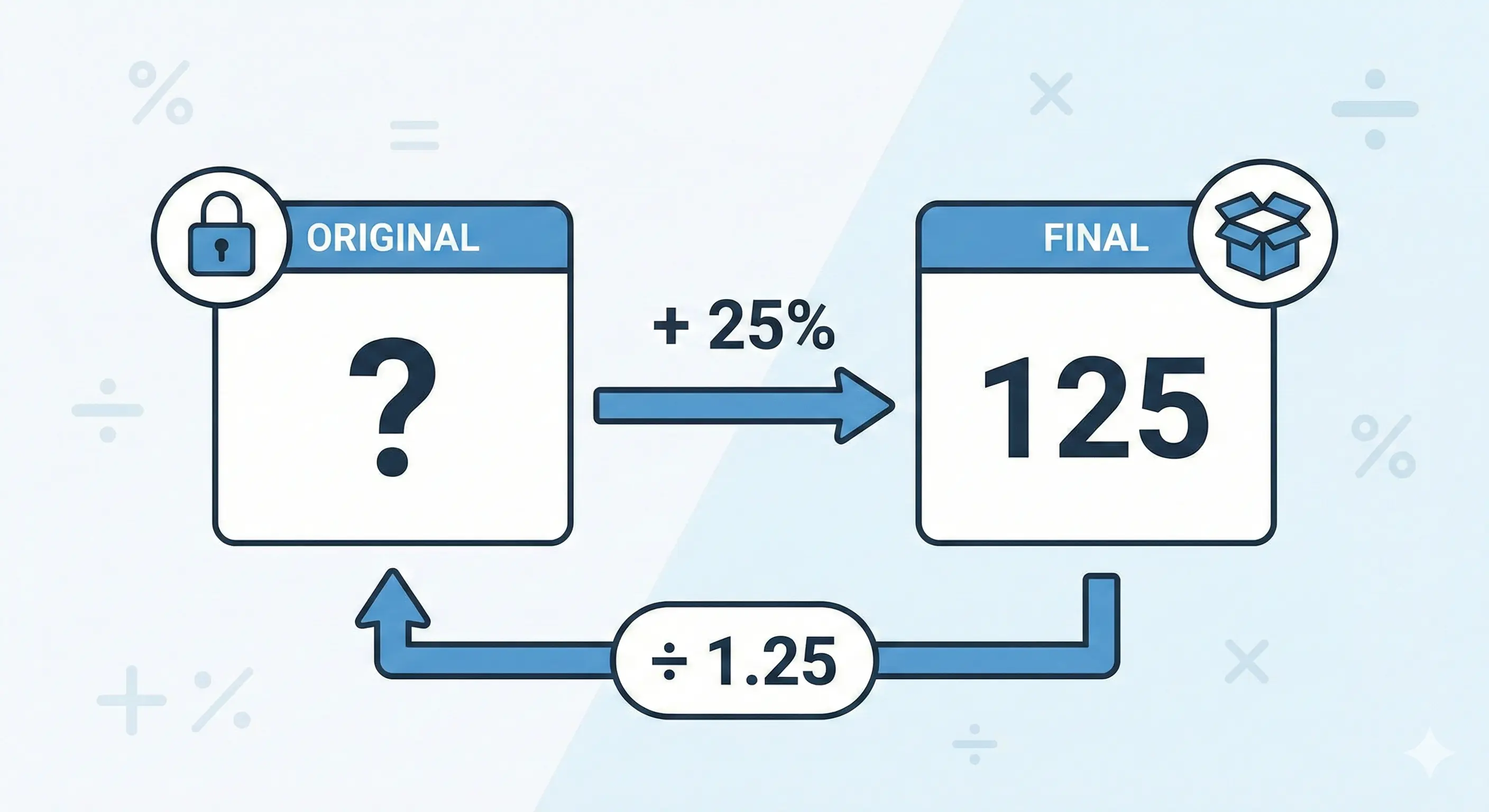
The formula is straightforward once you understand the core concept: any value after a percentage change represents a specific percentage of the original.
For increases:
Original Value = Final Value ÷ (1 + percentage/100)For decreases:
Original Value = Final Value ÷ (1 - percentage/100)Here's the logic: when something increases by 20%, the new value equals 120% of the original. When something decreases by 15%, the result equals 85% of the original. To find the original, simply divide by that percentage expressed as a decimal.
Quick Reference: Common Multipliers
Change | Divide by | Change | Divide by |
|---|---|---|---|
+5% | 1.05 | -5% | 0.95 |
+10% | 1.10 | -10% | 0.90 |
+15% | 1.15 | -15% | 0.85 |
+20% | 1.20 | -20% | 0.80 |
+25% | 1.25 | -25% | 0.75 |
+50% | 1.50 | -50% | 0.50 |
Example 1: Finding the Original Price Before a Discount
Problem: A laptop costs $680 after a 15% discount. What was the original price?
Solution:
The sale price represents 85% of the original (100% - 15%)
Convert to decimal: 85% = 0.85
Calculate: $680 ÷ 0.85 = $800
Verification: $800 × 0.15 = $120 discount → $800 - $120 = $680 ✓
Example 2: Calculating Original Salary Before a Raise
Problem: After a 12% raise, Sarah earns $61,600 annually. What was her previous salary?
Solution:
New salary represents 112% of the original (100% + 12%)
Convert to decimal: 112% = 1.12
Calculate: $61,600 ÷ 1.12 = $55,000
Verification: $55,000 × 0.12 = $6,600 raise → $55,000 + $6,600 = $61,600 ✓
Example 3: Finding the Pre-Tax Price
Problem: You paid $86.40 for dinner including 8% sales tax. What was the price before tax?
Solution:
Total represents 108% of pre-tax price (100% + 8%)
Convert to decimal: 108% = 1.08
Calculate: $86.40 ÷ 1.08 = $80.00
Verification: $80.00 × 0.08 = $6.40 tax → $80.00 + $6.40 = $86.40 ✓
Handling Multiple Percentage Changes
When dealing with successive changes, work backward through each one in reverse order.
Problem: A jacket costs $68 after a 15% discount applied to an already reduced price. The first discount was 20%. What was the original price?
Solution:
$68 represents 85% of the price after the first discount
$68 ÷ 0.85 = $80
$80 represents 80% of the original price
$80 ÷ 0.80 = $100
Verification: $100 × 0.80 = $80 → $80 × 0.85 = $68 ✓
Common Mistakes to Avoid
Mistake 1: Applying the Opposite Percentage
Many people think that reversing a 20% increase means subtracting 20%. This is wrong.
Why it fails: A 25% increase followed by a 25% decrease does NOT return the original value:
$100 + 25% = $125
$125 - 25% = $93.75 (not $100!)
Each percentage applies to a different base value. Always use division with the correct multiplier.
Mistake 2: Confusing Percentage Points with Percentages
If an interest rate changes from 5% to 8%, that's a 3 percentage point increase, but a 60% relative increase (3÷5 = 0.6). Know which type of change you're dealing with.
Mistake 3: Rounding Too Early
In multi-step problems, keep extra decimal places until the final answer. Premature rounding compounds errors.
Practical Applications
This calculation appears in many real-world scenarios:
Shopping: Finding original prices before sales
Finance: Calculating initial investments from current portfolio values
Accounting: Determining pre-tax amounts from totals
HR: Understanding previous salaries before raises
Real Estate: Finding property values before appreciation
Business: Calculating wholesale costs from retail prices with markup
FAQ
Can I reverse a percentage by applying the opposite operation?
No. You cannot reverse a 20% increase by applying a 20% decrease. The percentages apply to different base values. A 20% increase multiplies by 1.20, and a 20% decrease multiplies by 0.80. Together: 1.20 × 0.80 = 0.96, leaving you at 96% of the original, not 100%. Always use division with the correct multiplier.
How do I handle decimal tax rates like 6.5%?
The same way as whole numbers. If tax is 6.5%, the total represents 106.5% of the pre-tax price. Divide by 1.065 to find the original amount.
Example: $127.80 total with 6.5% tax → $127.80 ÷ 1.065 = $120.00 pre-tax
Why do my calculations sometimes differ slightly when I verify them?
This usually results from rounding. Maintain several decimal places throughout your calculations and only round the final answer. Small differences (a few cents) typically indicate rounding rather than errors in your approach.
Step-by-Step Checklist
Identify whether the change is an increase or decrease
Calculate what percentage the final value represents (100% ± change)
Convert to a decimal (divide by 100)
Divide the final value by this decimal
Verify by applying the percentage forward
Conclusion
Reverse percentage calculation lets you work backward from a known result to find the original value. The key principle is simple: divide the final amount by the decimal representing what percentage it is of the original.
For increases, add the percentage to 100% before converting. For decreases, subtract it. With practice, these calculations become intuitive, helping you make better financial decisions whether you're shopping, analyzing investments, or reviewing salary changes.
Remember: you cannot reverse a percentage by applying the opposite operation with the same number. Always use the formula, and verify your answer by calculating forward.