Percentage Share: Formula and Examples
A compact guide to percentage share with the core formula, quick examples, and a simple rule you can reuse.
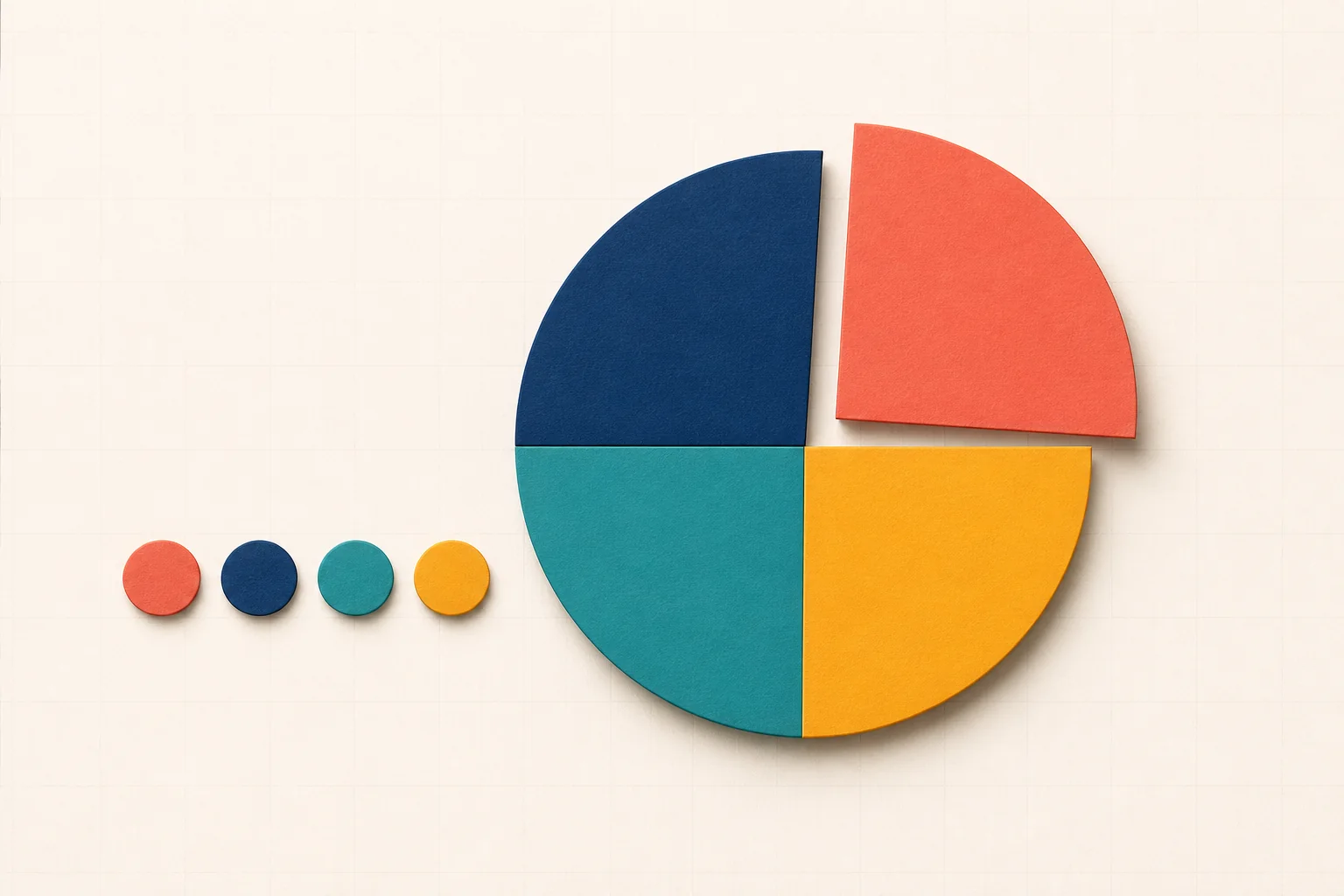
Percentage share answers one question: out of the whole, how big is this slice? Revenue from one product against total revenue. Leads from one channel against all leads. The math is plain part-over-total, and it is the same calculation as percentage of total. What trips people up is almost never the division. It's the total they divide by.
Percentage share = (part / total) × 100
Say one channel brought 45 of your 180 leads last month. 45 / 180 = 0.25, so that channel is 25% of your leads. A product with 30 of 120 sales works out the same way: 0.25, or 25%. The steps never change. Take the part, divide by the real total, multiply by 100.
The total is the part that goes wrong
Nearly every wrong share I've had to fix came from the denominator, not the arithmetic.
- Dividing by the wrong total. For a product's share of revenue, the denominator is total revenue, not total units sold and not the biggest competitor's number. It sounds too obvious to matter. It's still the most common mistake.
- Overlapping categories. Shares only add to 100% when every part belongs to the same whole and nothing is counted twice. A customer who came through two channels cannot be credited fully to both, or your shares quietly climb past 100%.
- Mixing time periods. This month's part over last month's total is a number that means nothing. Keep both sides in the same window.
When the shares refuse to add up to 100%
Round each share to a whole number and they'll often sum to 99% or 101%. Three equal thirds round to 33% + 33% + 33% = 99%. That's not a bug, it's rounding. The usual fix is to let the largest slice absorb the leftover (33% + 33% + 34%) so the total reads 100%. If a chart has to sum exactly, do that on purpose rather than hoping the numbers cooperate.
Share or change? Different questions
If you are asking what slice of the whole something is, that's share. If you are asking how much it grew from before, that's percentage change, a completely different formula. Same percent sign, different question. It's worth being sure which one the person asking actually wants before you hand them a figure, because the two are easy to mix up and the numbers can look plausible either way.
Where you'll actually use it
Revenue by product, traffic by channel, budget by department, survey answers by option. Market share is this exact formula with your sales as the part and the whole market as the total. Once the total is defined correctly, the rest is one division.
FAQ
Is percentage share the same as percentage of total?
Yes, the arithmetic is identical. "Share" is just the business-flavoured name, usually used when the parts are competing with each other (products, channels, vendors) rather than being a neutral breakdown of a total.
Can shares add up to more than 100%?
Not if every part belongs to one total and the categories don't overlap. If they can add up to more, that's usually a sign your categories overlap and need cleaning up, not that the formula is wrong.