Percentage Points vs Percent: What Is the Difference?
Percent and percentage points are not the same. Here is the simplest way to tell them apart, plus examples you can copy for reports.
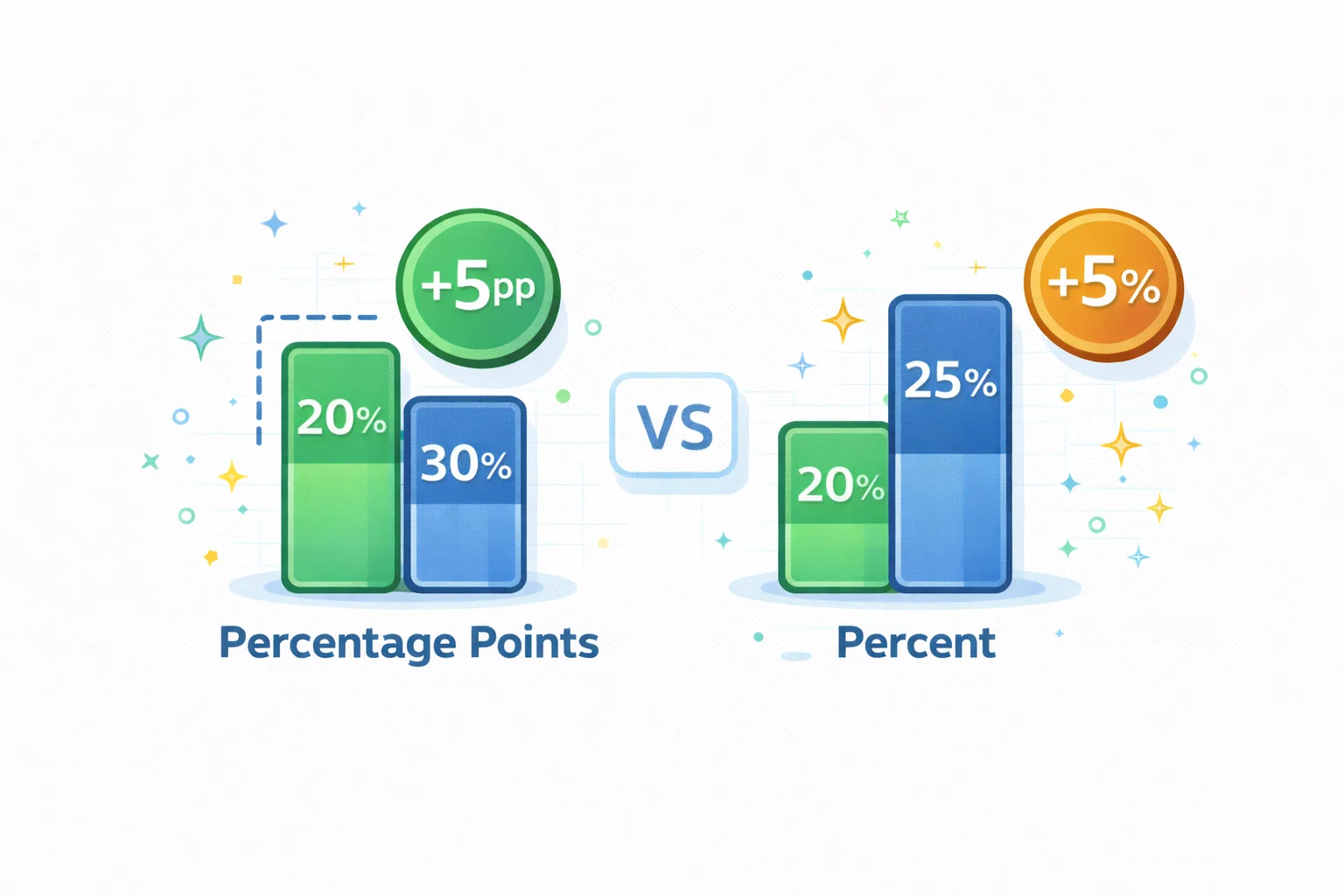
Percentage points vs percent in one sentence
Use percentage points for the difference between two percentages. Use percent for relative change.
The key idea
When you compare two rates, you are comparing percentages. There are two common ways to express the change:
- Absolute change: measured in percentage points
- Relative change: measured in percent
Example: conversion rate from 2% to 3%
Old rate: 2% New rate: 3%
Change in percentage points
3% - 2% = 1 percentage point
Change in percent (relative)
(3% - 2%) / 2% = 0.5 = 50% So the rate increased by 50%.
Both statements can be correct, but they mean different things.
Example: interest rate from 4.5% to 6%
Old rate: 4.5% New rate: 6%
Change in percentage points: 6% - 4.5% = 1.5 percentage points
Relative change: (6 - 4.5) / 4.5 = 0.333... = 33.33%
Quick rule you can memorize
- If you subtract two percentages, the unit is percentage points.
- If you divide a change by the original value, the unit is percent.
Common mistakes
- Saying a rate increased by 1% when you mean 1 percentage point.
- Mixing percent and percentage points in the same sentence.
- Forgetting the baseline when reporting relative change.
FAQ
Are percentage points the same as percent?
No. Percentage points measure the absolute gap between two percentages. Percent measures relative change.
Which one should I use in reports?
If you are talking about rates (conversion, CTR, interest), percentage points are usually clearer. If you want to emphasize growth relative to the baseline, use percent.
Can I calculate this with a calculator?
Yes. Use calculate-percentage.online for percent changes. For percentage points, just subtract the two percentages.